Explore our network of country and industry based websites to access localized information, product offerings, and business services across our group.
Log in to start sending quotation requests for any product.
Don't have an account? Sign Up Here
Home Sodium Sulphate Anhydrous Market Insight for Paper Industry in Asia (2026)
Trade Insights | Applications and Buyers | 05 January 2026
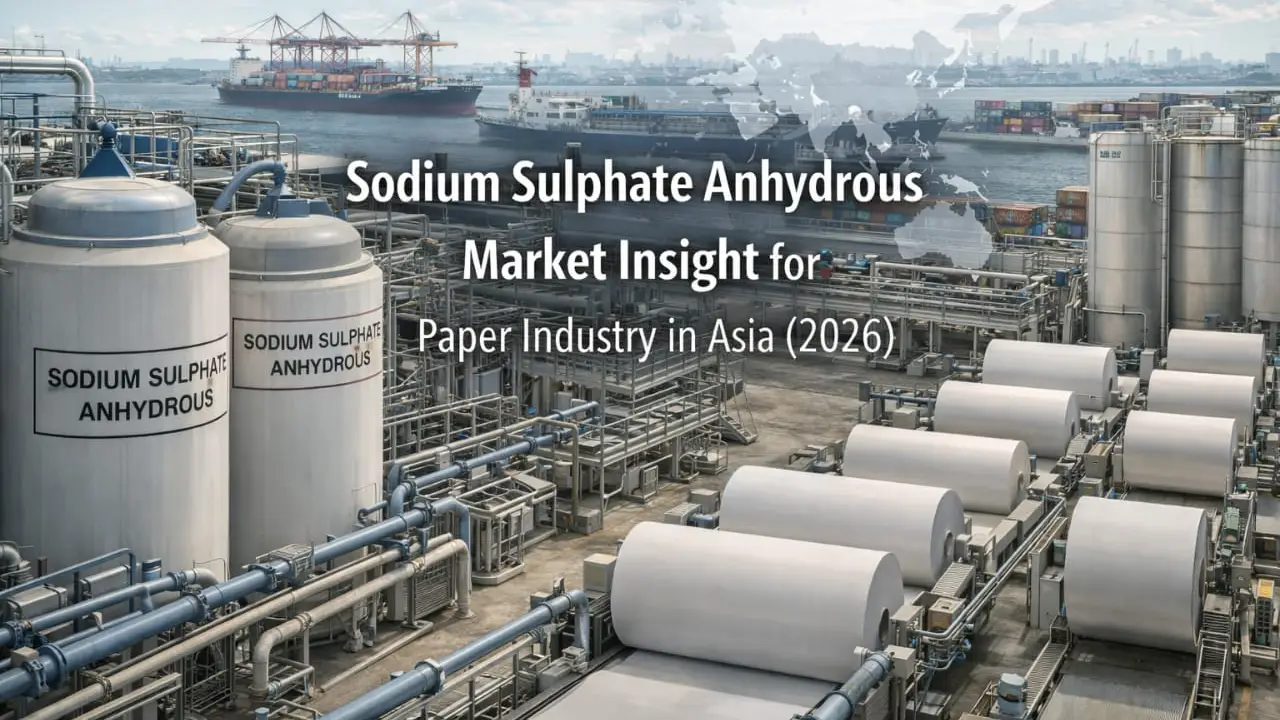
Sodium sulphate anhydrous market conditions in Asia for 2026 show stable growth, mainly driven by steady paper and pulp production. The chemical remains an essential input in kraft pulping and chemical recovery systems, supporting consistent paper output across the region. While demand continues at a controlled pace, many Asian markets still depend heavily on imports, making supply planning an important factor for buyers.
Demand trend: Steady – Paper and pulp production across Asia Pacific continues to grow at a gradual pace. Packaging demand, supported by e-commerce, food delivery, and retail logistics, keeps sodium sulphate usage stable in kraft-based paper mills.
Supply condition: Import-reliant – Southeast Asian countries meet around 60–70% of their sodium sulphate anhydrous demand through imports. China and India remain the main suppliers, with total Asian trade volumes exceeding 10 million tons per year under HS code 2833.11.
Pricing pressure: Moderate – Prices stabilized during Q3 2025 due to balanced production and controlled demand. Looking ahead to 2026, pricing is expected to remain steady, though energy costs and freight rates may cause short-term movement.
Buyer risk level: Medium – Dependence on imports exposes buyers to logistics delays and port congestion. However, strong and consistent output from China helps reduce the risk of sudden shortages.
As Asia enters 2026, the sodium sulphate anhydrous market for paper manufacturing remains well balanced. Kraft pulping continues to dominate demand, with mills recovering and reusing sodium sulphate as part of closed-loop chemical systems. China accounts for roughly 60% of global exports, supplying major paper-producing countries such as India, Indonesia, and Thailand.
During Q3 2025, prices across South and Southeast Asia remained stable due to sufficient inventories and predictable demand from paper and detergent sectors. Trade data indicates steady flows rather than sharp growth, suggesting that supply is largely keeping pace with consumption. Overall, buyers can expect reliable availability, though transport and port capacity remain key external risks.
Growth in China’s paper sector continues to support sodium sulphate demand, particularly in kraft pulp mills producing packaging and industrial paper. The rise of online shopping has increased the need for corrugated boxes, directly supporting chemical consumption.
In East Asia, government policies limiting plastic use have pushed demand toward paper-based alternatives. This shift supports new mill investments and upgrades, increasing demand for pulping chemicals. Southeast Asia also contributes to steady growth, driven by urban population growth, hygiene paper use, and commercial printing. Together, these factors keep sodium sulphate anhydrous demand stable rather than volatile.
China and India form the backbone of sodium sulphate anhydrous production in Asia. China alone supplies over 60% of exported volumes, filling supply gaps in import-dependent Southeast Asian markets. Countries in this sub-region import an estimated 200,000 to 250,000 tons per year for paper-related use.
Logistics remain sensitive to fuel costs, shipping rates, and port congestion. However, 2025 trade figures show year-on-year growth of about 2.5%, suggesting that producers have enough capacity to meet paper sector needs in 2026. Short-term tightness may still occur during peak kraft production periods, making long-term supply agreements more attractive for large buyers.
Paper manufacturers should focus on suppliers that meet kraft-grade purity and consistent quality standards, as recovery systems are sensitive to impurities. Compliance with environmental and safety regulations similar to REACH is increasingly important for cross-border trade.
Typical lead times from China and India range from four to six weeks, so forward planning is essential. Buyers in high-import markets such as Indonesia benefit from sourcing diversification to reduce exposure to port delays. Partnering with experienced distributors like paperchemicalsasia helps buyers manage pricing risks, secure reliable supply, and maintain production stability.
The sodium sulphate anhydrous market in Asia is set to remain stable in 2026, supported by steady paper and pulp production growth. While demand is not expanding rapidly, it is consistent and closely tied to packaging, hygiene paper, and kraft pulping operations. Import reliance, especially in Southeast Asia, keeps logistics and supplier selection critical for buyers. Companies that plan ahead, secure long-term contracts, and work with trusted suppliers will be best positioned to manage costs and ensure uninterrupted paper production in the year ahead.
We're committed to your privacy. Tradeasia uses the information you provide to us to contact you about our relevant content, products, and services. For more information, check out our privacy policy.


 English
 Indonesian
 简体字
简体字
 العربية
 Español
 Français
 Português
 日本語
日本語
 한국어
한국어
 Tiếng Việt



















