Explore our network of country and industry based websites to access localized information, product offerings, and business services across our group.
Log in to start sending quotation requests for any product.
Don't have an account? Sign Up Here
Home Sodium Sulphate Anhydrous Uses in Kraft Paper Manufacturing and Chemical Recovery
Trade Insights | Applications and Buyers | 05 January 2026
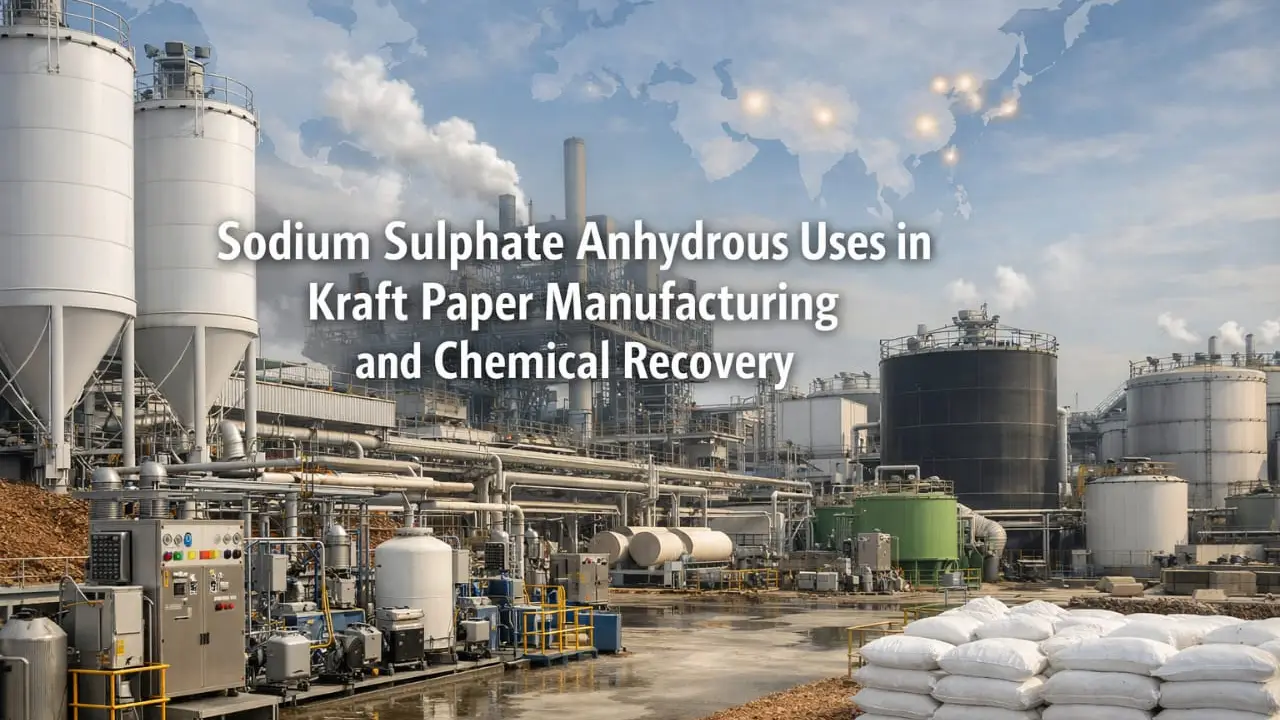
Sodium sulphate anhydrous (Na₂SO₄) is a key raw material in the pulp and paper industry, especially in kraft paper production. It appears as a white, dry crystalline powder that dissolves easily in water. Paper mills depend on high-purity grades—usually above 99%—to keep pulping and chemical recovery systems running smoothly. When used correctly, sodium sulphate anhydrous helps stabilize process chemistry, protect equipment, and support consistent paper quality without adding harmful impurities.
In kraft pulping, sodium sulphate anhydrous mainly acts as a makeup chemical and sulfur source. During high-temperature cooking, sulfur compounds are lost through gas emissions and liquor spills. Sodium sulphate replaces this lost sulfur, helping maintain the balance between sodium hydroxide and sodium sulfide in the cooking liquor.
This balance is essential for breaking down lignin while protecting cellulose fibers. Sodium sulphate anhydrous also helps keep the system alkaline, reducing the risk of sudden pH drops caused by lignin breakdown. Unlike sodium sulfite, which reacts directly with lignin, sodium sulphate works indirectly by supporting chemical recovery and steady pulping conditions.
Paper mills add sodium sulphate anhydrous early in the kraft process, usually during white liquor preparation. The white liquor, made of sodium hydroxide and sodium sulfide, is used to cook wood chips at temperatures between 160 and 170°C. This step separates fibers efficiently and improves pulp yield.
In the chemical recovery loop, sodium sulphate plays an even larger role. Modern mills recover most pulping chemicals by concentrating black liquor, burning it in recovery boilers, and converting smelt back into usable liquor. Sodium sulphate helps replace sulfur losses in this loop, allowing mills to reuse up to 95% or more of their chemicals.
During pulp washing and preparation for bleaching, sodium sulphate anhydrous improves process stability. It helps control foam, improves liquid drainage, and keeps pulp consistency stable for downstream steps. Some integrated mills also use it in recycled fiber processing to reduce yellowing under alkaline conditions, although usage levels are lower than in virgin pulp production.
Sodium sulphate anhydrous is most important in kraft-based paper grades such as printing paper, packaging board, linerboard, and tissue. In bleached pulp grades, it supports brightness and fiber strength by maintaining a stable recovery cycle. Containerboard and linerboard producers rely on it to improve yield and reduce chemical makeup costs.
For recycled paper and newsprint, its role shifts toward deinking and process control. Lower concentrations help improve ink removal without damaging fibers. Specialty paper mills, such as sack kraft or linerboard producers using batch digesters, depend on accurate sulphate dosing to avoid undercooking or fiber damage, especially when processing dense softwood species.
Using sodium sulphate anhydrous efficiently can reduce total chemical costs by 5–10%. It lowers the need for fresh caustic soda and improves recovery boiler performance. Because it remains stable at high temperatures, it reduces scaling and corrosion risks caused by pH swings, helping extend equipment life and reduce downtime.
Better pulp washing also leads to energy savings. Improved pulp consistency reduces steam use during drying, cutting energy demand by roughly 2–4% per ton of paper. These efficiency gains are especially valuable for high-volume mills operating under tight margins.
From a cost perspective, sodium sulphate anhydrous remains one of the more affordable recovery chemicals. Its wide availability—often as a by-product of rayon and metal processing—allows mills to secure long-term supply contracts and manage price volatility.
While sodium sulphate anhydrous is used in detergents, textiles, and glass, paper manufacturing requires much stricter quality control. In detergents, it mainly acts as a filler. In textiles, it helps control dye uptake. In glass, it removes bubbles during melting.
Paper mills, however, need low-moisture material with controlled particle size to avoid upsetting liquor chemistry. Chloride content must remain low to protect recovery boilers from corrosion. Poor-quality supply can increase operating costs significantly, making supplier reliability far more critical in paper production than in other sectors.
Paper producers typically source sodium sulphate anhydrous in bulk or 50-kg bags, depending on mill size. Key quality requirements include high whiteness, consistent particle size for fast dissolution, low moisture content, and minimal heavy metals. Mills often test incoming material to ensure it meets internal and international standards.
Asia-Pacific remains the main supply region, with China and India supporting a large share of global demand. Long-term contracts are common, helping mills secure stable pricing and uninterrupted supply as kraft capacity continues to grow.
Sodium sulphate anhydrous supports sustainability goals by enabling chemical recycling and reducing waste. Effective recovery systems prevent large amounts of sulfate from entering wastewater streams. High-purity grades also help mills stay within sulfate discharge limits set by environmental regulations in Southeast Asia, the EU, and other regions.
Lifecycle studies show that recovered kraft systems using sodium sulphate generate lower carbon emissions compared to non-recovery operations. By keeping chemicals in a closed loop, mills reduce landfill waste and improve overall environmental performance.
Sodium sulphate anhydrous is an essential chemical in modern kraft paper manufacturing. Its main value lies in maintaining sulfur balance, supporting chemical recovery, and improving process stability across multiple production stages. When sourced at the right quality and used correctly, it helps paper mills lower costs, save energy, meet environmental standards, and produce consistent paper grades. For kraft-based operations, sodium sulphate anhydrous is a foundation of efficient and sustainable production.
We're committed to your privacy. Tradeasia uses the information you provide to us to contact you about our relevant content, products, and services. For more information, check out our privacy policy.


 English
 Indonesian
 简体字
简体字
 العربية
 Español
 Français
 Português
 日本語
日本語
 한국어
한국어
 Tiếng Việt



















