Explore our network of country and industry based websites to access localized information, product offerings, and business services across our group.
Log in to start sending quotation requests for any product.
Don't have an account? Sign Up Here
Home Global Calcium Carbonate Market Trends in the Paper Industry 2025
Trade Insights | Applications and Buyers | 12 August 2025
Introduction to Calcium Carbonate in Paper Manufacturing
Global Market Overview in 2025
Role of Calcium Carbonate in Paper Production
Key Market Drivers
Growth in Packaging Demand
Shift Toward Cost-Effective Fillers
Environmental and Sustainability Factors
Major Application Segments in the Paper Industry
Coated Paper
Uncoated Paper
Specialty Papers
Regional Trends and Trade Flows
Asia-Pacific
Europe
North America
Middle East & Africa
Supply Chain Insights and Key Producers
Pricing Trends in 2025
Challenges and Risks
Opportunities for Suppliers and Buyers
Conclusion and Future Outlook
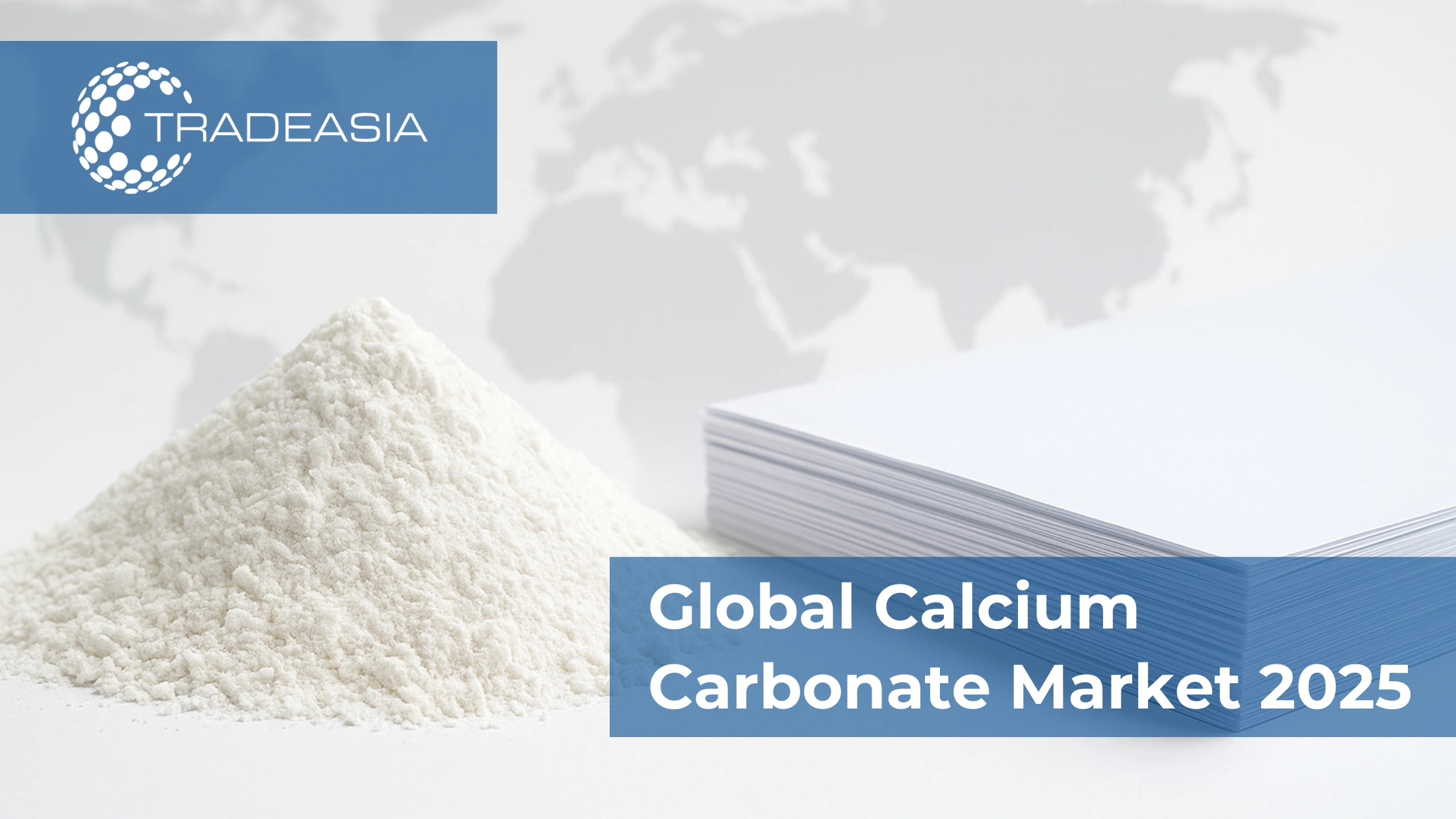
Calcium carbonate is one of the most widely used minerals in the paper manufacturing industry, serving as both a filler and coating pigment. Its ability to improve paper brightness, opacity, and surface smoothness has made it an indispensable component for producing high-quality printing, writing, and packaging papers.
In 2025, the global paper industry continues to rely heavily on calcium carbonate, with growing demand fueled by packaging needs, eco-friendly production trends, and technological advances in paper coating processes. This versatile mineral not only enhances paper performance but also helps manufacturers reduce production costs by replacing more expensive fiber content.
The global calcium carbonate market for the paper industry is expected to maintain steady growth in 2025, despite broader challenges in the pulp and paper sector. While demand for newsprint and certain grades of writing paper has declined due to digitization, packaging, specialty, and hygiene paper segments are driving new consumption.
Asia-Pacific remains the largest market for calcium carbonate in paper manufacturing, followed by Europe and North America. The shift toward sustainable, recyclable, and lightweight paper products has led to increased adoption of high-purity calcium carbonate grades.
Calcium carbonate is used in two main forms in paper manufacturing: ground calcium carbonate (GCC) and precipitated calcium carbonate (PCC).
GCC is produced by grinding natural limestone and is typically used as a filler.
PCC is synthetically produced to achieve specific particle sizes and shapes, often used for high-end coated papers.
Both forms contribute to enhanced print quality, reduced ink absorption, and improved sheet formation. They also lower the overall cost of paper production by reducing the reliance on wood fiber.
The rapid growth of e-commerce, food delivery, and retail packaging has boosted demand for paperboard and corrugated materials. Calcium carbonate plays a key role in producing smooth, strong, and printable packaging grades.
As pulp prices remain volatile, manufacturers increasingly turn to calcium carbonate as a cost-effective alternative to fiber. The ability to maintain quality while reducing raw material expenses is a significant driver.
Calcium carbonate enables lighter paper grades without compromising strength, reducing transportation emissions. Additionally, it is abundant, recyclable, and aligns with sustainable manufacturing goals.
Calcium carbonate is extensively used in coated papers for magazines, brochures, and high-end packaging. PCC offers superior surface smoothness and brightness.
In uncoated grades, GCC improves opacity and printability, particularly in office and printing papers.
Specialty papers such as décor, thermal, and security papers benefit from tailored PCC formulations that enhance performance characteristics.
China, India, and Southeast Asia lead global consumption, supported by large-scale paper mills and strong export markets.
European manufacturers focus on high-quality coated grades and sustainable paper solutions. PCC production is integrated within many mills.
North American demand is driven by packaging and specialty papers, with a stable supply base for GCC and PCC.
While smaller in market share, this region shows growth potential due to increasing packaging production.
The calcium carbonate supply chain involves mining, processing, and often on-site PCC production at paper mills. Major global producers include Imerys, Omya, and Minerals Technologies Inc., each operating regionally optimized supply networks.
Prices for calcium carbonate in 2025 are relatively stable, supported by abundant raw material supply. However, energy costs and logistics disruptions can influence short-term fluctuations.
Rising energy and transportation costs.
Environmental regulations in mining and production.
Competition from alternative fillers like kaolin.
Development of high-performance PCC grades tailored to specialty papers.
Expansion into emerging markets with growing packaging needs.
Partnerships between suppliers and mills for integrated PCC plants.
The global calcium carbonate market in the paper industry is positioned for steady growth through 2025. Packaging, sustainability trends, and technological advancements will continue to drive innovation. Suppliers who focus on quality, efficiency, and environmental responsibility will be best placed to capture market share in this evolving industry.
We're committed to your privacy. Tradeasia uses the information you provide to us to contact you about our relevant content, products, and services. For more information, check out our privacy policy.


 English
 Indonesian
 简体字
简体字
 العربية
 Español
 Français
 Português
 日本語
日本語
 한국어
한국어
 Tiếng Việt